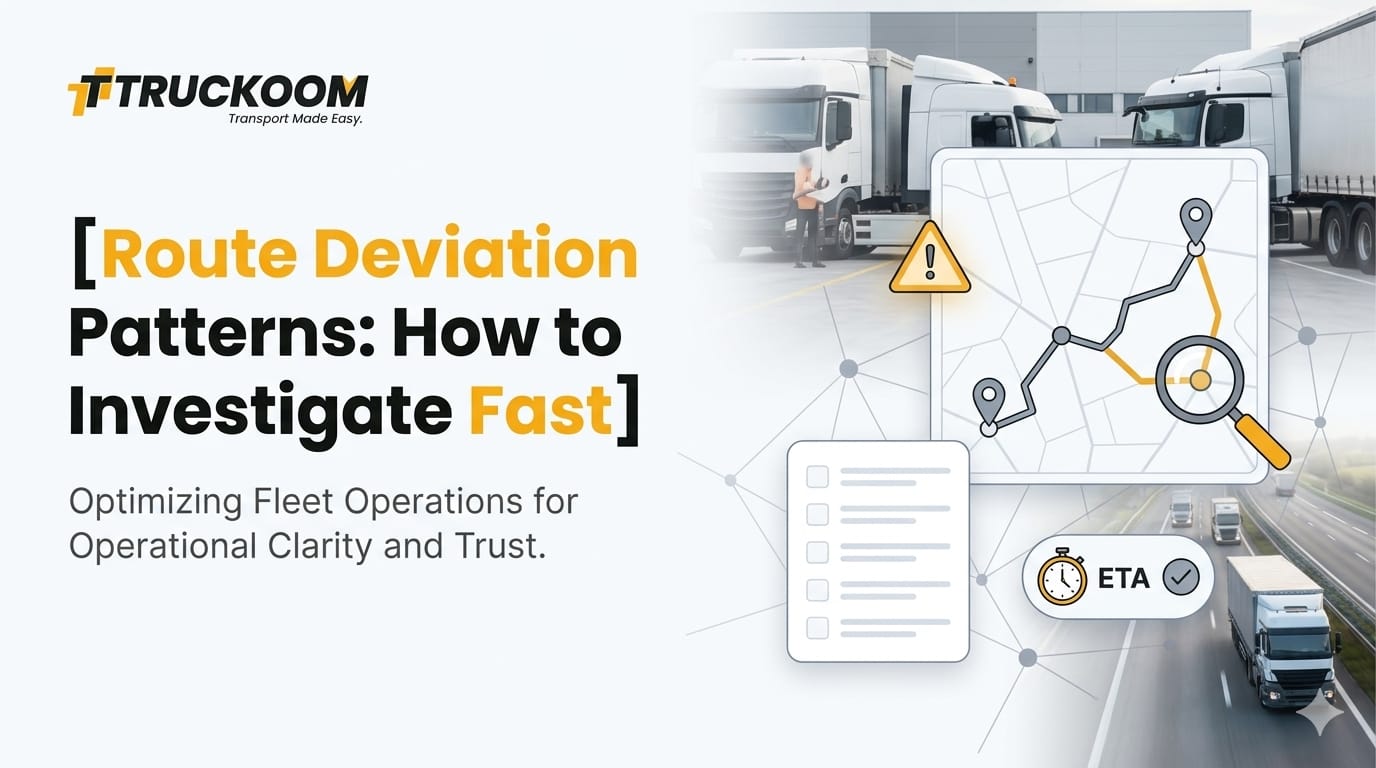

Route deviation is one of those fleet problems that looks small on a map—but shows up big in your cost line.
A driver takes a “slightly different way.” A vehicle makes an unplanned stop. A route takes 20 minutes longer than it should. Once or twice, it’s easy to ignore. But when the same patterns repeat across days, vehicles, and drivers, route deviation becomes a silent multiplier: more fuel burned, more overtime, more missed delivery windows, and more disputes about what actually happened.
At Truckoom, we see the best operations teams treat route deviation the same way they treat safety incidents: not with blame, but with a fast, repeatable investigation process.
This guide breaks down the route deviation patterns that matter—and a practical way to investigate them quickly so you can fix the root cause (instead of chasing one-off alerts).
What counts as “route deviation” (and what doesn’t)
Not every alternate route is a problem.
Route deviation becomes a concern when it creates one or more of the following:
- A measurable increase in time, distance, or fuel
- A missed appointment window or service-level target
- A compliance or safety risk (restricted roads, hazardous zones)
- A customer experience issue (late arrival, lack of predictability)
- A security risk (suspicious stops, theft exposure)
The goal isn’t to force every driver to follow one road. It’s to make sure the “actual route” still matches the “intended outcome”: on time, on budget, and within operational rules.
The route deviation patterns that usually signal a real issue
When deviation is random, it’s hard to manage. When it’s patterned, it’s fixable.
Here are the most common patterns to look for.
1) Same detour, same time of day
A consistent detour (for example, every morning between 8–10 AM) often means one of two things:
- Traffic conditions make the planned route unrealistic
- The plan is correct, but drivers are choosing convenience over policy
What to check fast:
- Compare planned vs. actual travel time by time-of-day
- Look for a consistent alternate corridor
- Check whether the detour improves ETA or makes it worse
2) Deviations clustered around specific customers or stops
If route drift happens only near one receiver, yard, or site, the cause is usually operational:
- Access restrictions, gate delays, or security procedures
- Poor dock coordination (drivers circling and waiting)
- Wrong entrance/incorrect location pin
What to check fast:
- Map the final 1–2 km of the trip
- Review dwell time patterns at that location
- Confirm the correct entry point and receiver contact process
3) Short, repeated “micro-deviations”
Micro-deviations often look harmless on a map—but add up across a fleet.
Common causes:
- Drivers avoiding small bottlenecks
- Inconsistent route guidance
- Local road changes not reflected in planning
What to check fast:
- Aggregate route variance (distance + minutes) across 20–50 trips
- Identify the 2–3 most repeated “drift segments”
4) Unplanned stops (especially in the same zones)
Unplanned stops are where deviation overlaps with cost and security.
Common causes:
- Personal stops
- Poor break planning
- Loading/unloading process gaps forcing drivers to wait elsewhere
- Security risk behavior (stopping near high-risk areas)
What to check fast:
- Stop duration + frequency (not just existence)
- Stop location type: fuel stations, industrial lots, residential zones
- Whether stops correlate with delay events or exceptions
5) Deviations that correlate with overtime, fuel variance, or claims
The most useful deviation analysis isn’t “who went off-route.” It’s “what did it cause?”
What to check fast:
- Routes where deviation aligns with overtime spikes
- Routes where deviation aligns with fuel variance
- Routes where deviation aligns with repeated customer complaints
A fast investigation workflow (15 minutes per incident)
When a deviation alert hits, speed matters. Not to punish—just to decide: ignore, clarify, or fix.
Use this 5-step workflow.
Step 1: Classify the deviation in 60 seconds
Ask three questions:
- Did it affect ETA or delivery window?
- Did it increase distance meaningfully?
- Is it in a restricted/high-risk area?
If the answer is “no” to all three, it’s likely noise.
If “yes” to any, keep going.
Step 2: Compare like-for-like (don’t compare everything)
The fastest way to misread deviation is to compare different trip types.
Compare only trips that match:
- Same origin–destination (or same route template)
- Same time-of-day window
- Similar vehicle/load type (where relevant)
You want a fair baseline: what “normal” looks like.
Step 3: Identify the deviation segment (where it changed)
Don’t stare at the whole route. Zoom into:
- The first point where the route diverged
- The duration of the divergence
- The merge point back to the route
This usually tells you whether it was:
- A tactical traffic detour (often short, merges back)
- A structural planning problem (repeated, consistent alternate route)
- An unplanned stop (stationary time plus location)
Step 4: Determine cause category (so the fix is obvious)
Assign one of these cause categories:
- Planning mismatch (planned route isn’t realistic)
- Customer/site constraint (access, dock, security)
- Driver behavior (policy or discipline issue)
- Tools/data issue (bad geofence, wrong pin, map data)
- Exception event (road closure, accident, weather)
The category matters because it determines who owns the fix.
Step 5: Choose an action (reduce recurrence)
Avoid the trap of “noted.” Pick one action:
- Update the planned route / route template
- Update geofences or location pins
- Adjust time windows and dispatch expectations
- Coach driver (with a specific, evidence-based example)
- Create a rule/threshold so the alert only fires when it’s meaningful
The goal is simple: fewer repeats.
How to reduce deviation noise (so teams focus on real issues)
One of the biggest reasons route deviation stays unsolved is alert fatigue. If everything is flagged, nothing is acted on.
A practical way to reduce noise:
- Set minimum thresholds (for example: deviation only if +X minutes or +Y km)
- Separate “route drift” from “unplanned stop” alerts
- Create a “repeat pattern” rule (flag only when the same deviation happens 3+ times)
- Assign ownership: dispatch investigates today; ops improves the system weekly
The Truckoom takeaway
Route deviation isn’t just a driver issue or a GPS feature. It’s an operations signal.
When you track patterns—not one-off detours—you can quickly tell the difference between a smart reroute and a costly habit. And with a repeatable investigation workflow, your team spends less time chasing dots on a map and more time fixing the system that causes drift.
If you want route deviation to stop being a surprise, you need two things: visibility into planned vs. actual—and a fast process to turn deviations into decisions.